21 Day Mobility Challenge: A Plan You Can Finish
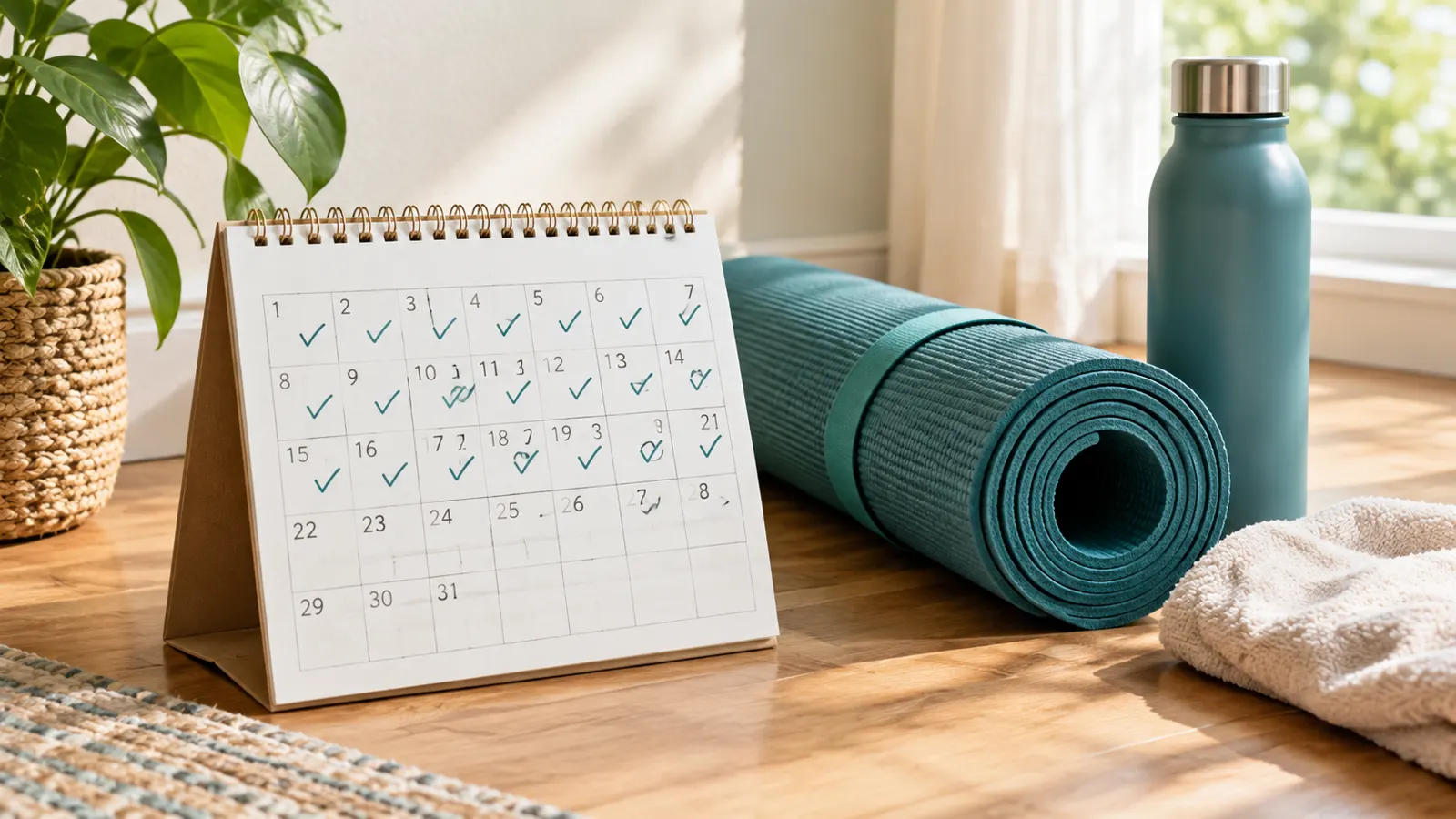
Most challenges fail for the same reason: they are built to impress, not to be finished. Thirty burpees, forty minutes, a cold shower. By day four you are negotiating with yourself, and by day six you have quietly dropped it. A 21 day mobility challenge works differently because the entry price is tiny. Ten minutes, no equipment, moves that feel good as you do them. The challenge is not intensity. It is showing up twenty-one times.
This guide lays out how to structure a 21-day mobility challenge so you actually finish it, what to focus on in each week, and how to see your own progress without guessing. It is general exercise education, not medical advice. If you have an injury, recent surgery or a health condition, talk to your doctor or physiotherapist before starting, and stop anything that hurts sharply.
Why three weeks works
Three weeks gives you three things a single weekend of stretching cannot.
A rhythm. After about a week, the routine starts to feel like part of the morning rather than an extra task. After three, skipping it feels odd.
Enough repetitions to notice a trend. Mobility changes slowly and quietly. You will not wake up on day eight transformed, but you may find on day fifteen that you put your socks on without holding your breath.
A finish line. "Do it forever" is a vague goal. "Do it for 21 days" is a concrete one, and finishing builds the confidence to go on.
The three-week shape
A good challenge does not repeat the same thing twenty-one times. It builds.
Week 1: Find your starting point (days 1 to 7)
Day one begins with a mobility check, a handful of simple tests: can you sit and rise from the floor, how far can you reach overhead with your back flat to a wall, how deep can you squat holding a support, how far can you turn your head and trunk each way. You are not grading yourself; you are recording where you start. Write it down.
The rest of week one is gentle: spine waves, hip circles, shoulder slides, ankle rocks. The goal is to teach your body that moving through range is safe. Stay well below your limit. If you finish a session feeling like you could do it again, you did it right.
Week 2: Build range where you are stiff (days 8 to 14)
Now you know your stiff spots, so you give them more time. For many people that is the hips, the middle of the back and the ankles. You spend a little more time in each position, add a slow breath out at the deep end, and begin to use light "active" holds, where you gently push the joint into its range with your own muscles. This is the step that turns passive stretching into real mobility, because your nervous system learns to control the new range.
Week 3: Link it into real movement (days 15 to 21)
Mobility only matters when it shows up in daily life, so the final week links the range into movements: getting up from the floor, a squat to a chair, a lunge with a reach, a step-up. You also repeat the mobility check on the last day and compare it with day one. For most people, the comparison is the most motivating part of the whole challenge.
What a single day looks like
Here is a typical day, around ten minutes:
- Minute 0 to 2: Easy spine and breathing work to settle in.
- Minute 2 to 6: Two or three main positions for the day's focus, held and moved through slowly.
- Minute 6 to 9: One linking movement, such as a supported squat or lunge with rotation.
- Minute 9 to 10: A slow finish, then tick the day on your tracker.
That last tick matters more than it looks. People who see a row of checkmarks build a streak they care about. If you like paper, a printable mobility tracker does exactly that.
How Limber 21 handles the challenge
Limber 21 is the 21-day version of this idea. It includes the mobility check at the start, a day-by-day plan of about 10 minutes, and a web app with guided routines so you do not need to remember the order. A printable 21-day tracker is available as an add-on, sold separately, if you want your three weeks on one sheet of paper.
What the program is not: a miracle, a medical treatment or a promise about a particular result. It is a structured, low-pressure way to move more fully for three weeks and to see for yourself what changed.
Rules that keep you in the game
- Same time, same place. Anchor the 10 minutes to something you already do: after brushing your teeth, before the first coffee.
- Lower the bar on bad days. A bad day gets the first two minutes and the final tick. That still counts.
- Stay under the discomfort line. A firm stretch is fine; sharp, pinching or numb is a stop sign.
- Do not stack on extra workouts in week one. Let your body adapt.
- Repeat the check, not the scale. Use movement you can observe, like reach and squat depth, not a number on a bathroom scale.
What to expect, honestly
Nobody can tell you what your body will do in three weeks, and you should be wary of anyone who does. Some people notice easier mornings; some notice better reach or an easier squat; some mainly notice that they have a routine again. What you can control is the process: ten minutes, daily, with a clear starting point and a clear comparison at the end.
After day 21
Do not stop on day 22. Choose one of three paths: repeat the challenge with slower tempo, pick the area you most want to improve and build a shorter daily routine around it, or move to a second block with stronger linking movements. The first path is perfectly good. Many people find the second round feels completely different because their body already knows the moves.
A starter you can try tonight
If you want to test the idea before committing, do this for three days. Each day: cat-cow for one minute, hip circles on all fours for a minute, a supported deep squat hold for a minute, a low lunge with an overhead reach on each side, and wall angels for a minute. Time it. If you can do that three days in a row, you are the kind of person who finishes a 21-day challenge. Then it is just a matter of having a plan with the order already worked out, so your only job each morning is to press play and move.