10 Minute Daily Mobility Routine for Busy Days
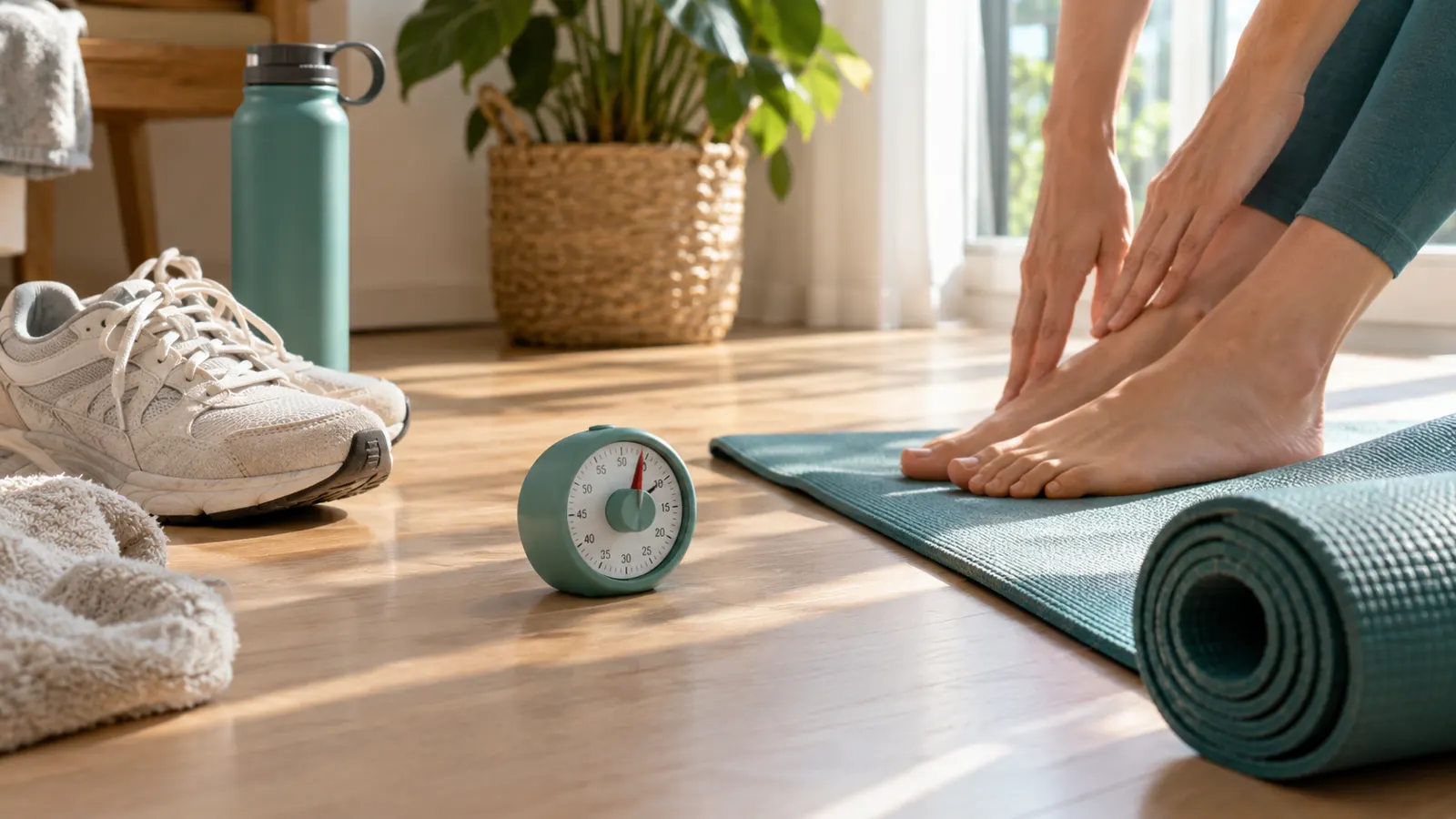
Ten minutes is not an arbitrary number. It is the longest time most people will reliably give to something every single day without negotiation. It is short enough to survive a bad morning and long enough to take the main areas of your body through a useful range. If you have ever abandoned a long program after a week, a 10 minute daily mobility routine is a better fit.
The plan below is minute by minute. It is general exercise education, not medical advice. If you have an injury, recent surgery or a health condition, talk to your doctor or physiotherapist before starting, and stop anything that causes sharp pain.
Why short and daily beats long and rare
Think of mobility like brushing your teeth. Two hours once a month would not do the job; two minutes twice a day does. Your joints and the muscles around them respond to repeated, controlled visits to their range, because your nervous system decides how much range to allow based on what it considers safe and familiar. Frequent, gentle visits tell it the range is safe.
A short routine also removes the biggest barrier to starting: the decision. You do not need to wonder whether you have time. You always have ten minutes.
The minute-by-minute plan
Set a timer, put on whatever you wear in the morning, and clear a patch of floor.
Minute 1: Breathe and roll. Lie on your back, knees bent. Breathe in through your nose for four counts, out for six. Gently roll your knees side to side.
Minute 2: Cat-cow. On hands and knees, round and arch slowly with your breathing.
Minute 3: Thread the needle. Slide an arm under your body, rest your shoulder, then open it to the ceiling. Thirty seconds per side.
Minute 4: Hip circles. Still on all fours, draw big circles with each knee, thirty seconds per side.
Minute 5: 90/90 switches. Sit with both knees bent and rotate your legs from one side to the other. Use your hands behind you for support.
Minute 6: Low lunge with reach. One minute total, thirty seconds per side, lifting the arm over your head.
Minute 7: Supported deep squat. Hold a door frame or chair. Sit as low as is comfortable and breathe out for a slow count.
Minute 8: Ankle rocks. Thirty seconds per side, heel down.
Minute 9: Wall angels. Slide arms up and down the wall, ribs down.
Minute 10: Stand tall and breathe. Reach up, take a deep breath in, and let your arms fall as you breathe out. Tick the day on your tracker.
That order is deliberate: floor first while you are stiff, then more upright positions as you warm up, and a calming finish.
The five-minute version
For busy days, keep minutes 2, 4, 6, 7 and 9. That covers spine, hips, front of the hip, squat pattern and shoulders. Five minutes done is worth more than ten minutes planned.
How to make it stick
Pair it with something you already do. Brush teeth, then mobility. Coffee machine on, then mobility while it brews. A habit hooked to an existing habit survives.
Leave your mat out. A mat rolled up in a closet is a mat you will not use. A mat on the floor at the foot of the bed is an invitation.
Track it. A tick on a paper sheet or a note on your phone makes the streak visible. A printable mobility tracker is useful for this, and we explain how to set one up in a separate guide.
Count the minimum version as a win. On bad days, doing two minutes counts. The aim is to never break the chain of showing up.
What you can reasonably expect
Ten minutes a day will not make you a gymnast, and nobody can promise you a particular change. What people commonly report from regular mobility practice is that everyday movements feel smoother: bending to tie shoes, getting out of a low chair, reaching to the back seat. Your mileage will vary. The way to know is to test yourself on day one and again a few weeks later with the same simple moves: how low can you squat holding a support, how far can you reach overhead against a wall, how comfortably can you sit on the floor and stand again.
How Limber 21 uses the ten minutes
Limber 21 is built on this exact time budget. The program runs 21 days at about 10 minutes a day. It starts with a mobility check so you can see your baseline and ends with the same check so you can compare. In between, the routines are guided in a web app, so there is no deciding what to do next. If your days are packed with meetings, there is also a set of 2 to 3 minute desk-day breaks, sold separately, for moving between calls.
Troubleshooting your ten minutes
"I am too stiff in the morning." Walk around for a minute or have a glass of water first. Start with smaller ranges. Your body warms up through the routine itself.
"My hips or knees complain on the floor." Use a cushion under your knees, or do the standing and chair versions. Sharp pain is a stop sign.
"I get bored." Change the order of the middle minutes every week, or play a favorite podcast. The moves can stay the same while the setting changes.
"I forgot for three days." Start again today. The routine does not hold a grudge.
A simple weekly check
Once a week, take thirty seconds to test one move: deep squat hold, overhead reach or sit-to-stand from the floor. Write down the date and how it felt. After a month, that tiny notebook is your best evidence. Use it to decide whether to keep your current routine, lengthen it or change focus.
Ten minutes is small enough to start tonight. Set a timer, roll out the mat and begin with minute one.