Mobility Routine for Seniors: Safe and Chair-Friendly
A good mobility routine for seniors has one job: help you keep doing the things you want to do. Get up from the couch without a push. Reach the top shelf. Turn to look over your shoulder when backing out of the driveway. Walk to the mailbox and enjoy it. None of this requires flexibility contests or a gym. It requires gentle, regular movement, support where you need it, and a plan that does not intimidate.
This guide covers safety first, then eight chair-friendly moves, then how to build them into a week. It is general exercise education, not medical advice. Talk to your doctor or physiotherapist before starting, especially if you have a health condition, a recent surgery, osteoporosis, balance problems or are on medication that affects dizziness.
Safety rules that come first
- Set up for stability. Use a sturdy chair without wheels, placed against a wall, and a counter or heavy table for standing support.
- Wear grippy shoes or non-slip socks, and clear the floor of rugs or cords.
- Move slowly. Speed is the enemy of balance.
- Stay at a comfortable effort, around 3 out of 10 or below. No sharp pain, no numbness, no dizziness.
- Breathe. Breathe out on the effort and never hold your breath.
- Keep a phone nearby, and exercise when someone is home if you feel unsure.
- Never close your eyes in balance-related positions. Keep a hand on support.
If anything feels off, stop. There is no award for pushing through.
Eight chair-friendly moves
Each move takes about a minute, and you can repeat it once if you like. The whole sequence takes around ten minutes.
1. Seated posture reset. Sit tall near the front of the chair. Gently draw your shoulder blades together, lift your chest and breathe in. Release and breathe out.
2. Seated cat-cow. Hands on knees, round your back as you breathe out and lift your chest as you breathe in.
3. Seated trunk rotation. Arms crossed over your chest, turn slowly to each side. Go only as far as is comfortable.
4. Shoulder slides on a wall or table. Place your forearms on a table or against a wall and slide them forward and back, opening the shoulders.
5. Seated knee lifts and ankle circles. Lift one knee, circle the ankle five times each way, then switch. This is good for circulation and for waking up the legs.
6. Seated figure-four stretch. Rest one ankle on the opposite knee and lean slightly forward with a straight back. This opens the outer hip. If it is too much, just rest the foot on the knee and sit tall.
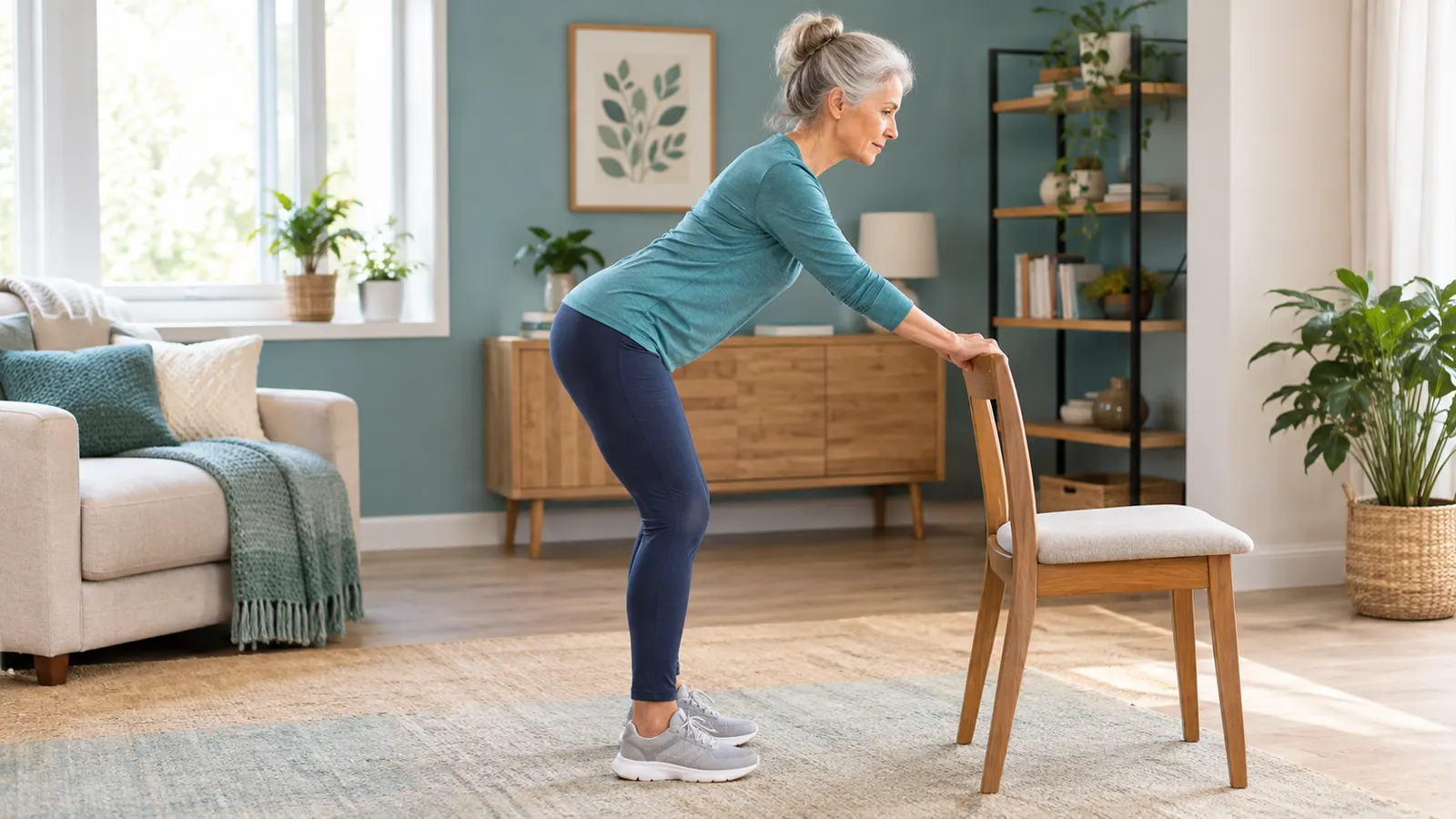
7. Supported hip hinge. Hold the back of a chair, push your hips back with a flat back as if closing a car door with your bottom, and return. This is the pattern for picking things up safely.
8. Sit-to-stand. Stand up from the chair with your hands crossed or lightly on your thighs, then sit slowly. Repeat five times. If it feels too hard, use your hands on the armrests.
You can finish with a minute of slow breathing, in through the nose for four counts and out for six.
Why these moves
They cover the areas that matter most for daily life: the spine, shoulders, hips and ankles, plus the movement patterns you use all day, like rising from a chair and bending. They are low-impact and they let you control how much of your weight you carry.
Building a week
A simple, forgiving plan:
- Monday, Wednesday, Friday: the full eight moves, around ten minutes.
- Tuesday, Thursday: half of them, or a short walk and three moves.
- Weekend: whatever you enjoy. A walk, gardening and a few easy moves count.
If you feel good after two weeks, add a second round of the sit-to-stand and the hip hinge. If you feel sore, stay where you are for a few more days. Slow and steady is the point.
Track what matters to you
Pick two or three everyday tasks and make them your yardstick. For example: how many tries to stand from your favorite chair; whether you can put on socks without holding your breath; whether you can turn to look behind you while parking. Write the date and the result once a week. After a month you will have a picture of your own trend that is far more useful than a general claim about what exercise "does".
What a guided plan can add
If you would rather follow along than design the plan, Limber 21 is a 21-day program built around about 10 minutes of movement a day. It begins with a mobility check, so you know where you start and can compare at the end, and then runs through guided routines in a web app. The moves are scaled to what feels comfortable, with the option to use a chair or wall. It is general exercise education, not a treatment or a promise of any particular result.
Common questions older adults ask themselves
"Am I too old to start?" Starting later does not make gentle movement pointless. People often find that they feel more capable simply by moving more regularly. Begin small and let your body tell you what suits it.
"What if my knees or hips ache?" Mild stiffness is common. Sharp pain, swelling or joints that lock are not, and need a professional's opinion. For knee and stair-related work, see our guide to mobility exercises for stairs.
"I worry about falling." That is a good reason to move, with support. Slow, supported balance practice and strong legs help. Keep a sturdy surface within reach and ask your professional about balance programs.
"I get tired quickly." Break the routine into two or three short mini-sessions across the day. Five minutes after breakfast and five minutes in the afternoon is every bit as valid.
A final word
You do not need to perform. You need to move a little, safely, most days. Start tomorrow with the first three moves, add one more each week, and keep a simple notebook. That is a real routine, and it is enough.