Hip Mobility Exercises for Stiff Hips at Home
Hips run your day. They are involved when you sit, stand, walk, climb, turn, lift and get out of a car. When they are stiff, other areas make up the difference: the lower back rotates too much, the knees twist, the ankles roll. That is why a handful of well-chosen hip mobility exercises for stiff hips can make ordinary movement feel noticeably smoother.
This guide explains why hips get stiff, how to check yours at home, and gives seven moves in a smart order. It is general exercise education, not medical advice. If you have hip pain, a diagnosis, recent surgery or any symptom that worries you, check with your doctor or physiotherapist first, and stop anything that causes sharp pain.
Why hips get stiff
The hip is a ball-and-socket joint designed for movement in every direction: forward and back, side to side and rotation. Modern life uses almost none of that. Hours in a chair keep the front of the hip shortened and the glutes sleepy. Walking on flat surfaces uses a small slice of the range. If you add a lack of variety in your workouts, the unused ranges simply fade from your body's comfort zone.
That does not mean damage. It often means "unfamiliar". Which is good news, because unfamiliar ranges can become familiar again with regular, gentle visits.
Test your hips in three minutes
Before the exercises, take a baseline. You are not grading yourself, only noting where you are.
- Floor sit. Can you sit cross-legged on the floor with a fairly upright back? Note if your knees are well above your hips.
- Supported deep squat. Hold a door frame, lower down and see how low you get with your heels down.
- Rotation check. Lying on your back with knees bent, let your knees fall to the left and right. Does one side drop much less than the other?
Write the date and a sentence for each. You will repeat them in two or three weeks.
Seven moves in a smart order
Each move takes about a minute. Move slowly and breathe out as you go deeper.
1. Knee rocks on your back. Knees bent, feet flat, let both knees fall side to side with small, easy movements. This calms the area.
2. Hip circles on all fours. Draw big slow circles with each knee, as if painting the inside of a barrel. Thirty seconds per direction.
3. 90/90 switch. Sit with both knees bent at ninety degrees and rotate from one side to the other. Place a folded towel under your hips if you are stiff, and keep a hand behind you.
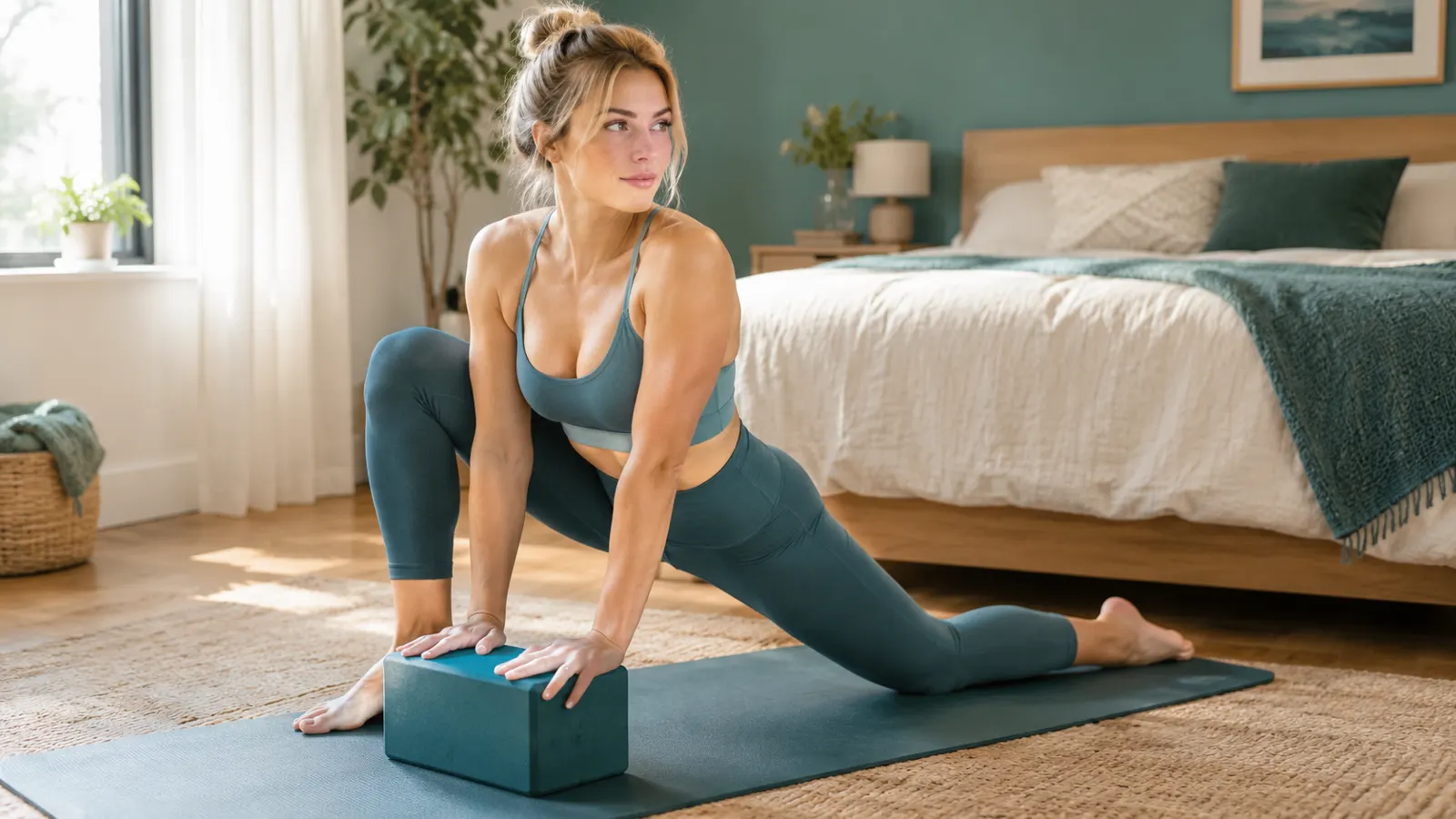
4. Low lunge with a reach. Step one foot forward, lower your back knee onto a cushion and lift the same-side arm. Squeeze the back glute gently. This opens the front of the hip, which sitting shortens.
5. Figure-four stretch. Lie on your back, rest an ankle on the opposite knee and draw the legs toward your chest. Stop where you feel a firm but comfortable stretch in the outer hip.
6. Frog or wide-knee rock. On hands and knees, widen your knees and gently rock back toward your heels. Use a cushion under your knees and hands on a chair if it is too much.
7. Glute bridge with a pause. Lie on your back and lift your hips, pausing for three seconds at the top. This turns the new range into something your muscles can control.
Finish by hugging your knees to your chest for ten slow breaths.
Why include a strength move
Mobility is range plus control. If you only stretch, your body may feel a new range but not trust it. The bridge, and an active hold at the end of a lunge or squat, tells your nervous system that the range is safe to use. Many people find this is what makes the progress last.
How hard should it feel
You want a firm stretch or mild effort, a 3 out of 10 or below. If a stretch pinches in the front of the hip, you are probably too deep or too fast. Back off, or change the angle. Always avoid forcing a range and never bounce.
Fitting hips into your day
You do not need an extra hour. Try:
- Two minutes after you wake up: 90/90 switches in bed or on the floor.
- At your desk, once an hour: stand and do a half-lunge hold with the chair as support. Our guide to mobility exercises for desk workers has more.
- Watching TV: figure-four stretch on the floor or the sofa.
- On the stairs: stand tall and take the last step with a slow, controlled push. If stairs are your main challenge, see our guide on mobility exercises for stairs.
How Limber 21 treats the hips
Hips are a core part of Limber 21, a 21-day program of about 10 minutes a day. It starts with a mobility check that includes a squat and floor-sit style test, then moves through hip, spine, knee and foot sessions in a web app, so hips are worked in the context of the whole body rather than alone. At the end of the three weeks you repeat the check. That comparison, not a promise, is the point.
What progress looks like
Progress in hip mobility is usually quiet. It looks like:
- Your squat holds a little longer before your heels lift.
- You sit on the floor and get up with one less hand on the furniture.
- Your two sides feel more similar.
- Standing up after a long sit takes less warm-up.
If you notice none of this after three weeks, that is information too. Reassess your technique, adjust the effort, or ask a professional to look at how you move.
Mistakes to avoid
Stretching cold and hard. Warm up with walking or easy circles first.
Ignoring the back of the hip. Many people stretch the front and neglect the glutes and rotators. Include both.
Forcing the knees down. In seated and floor positions, the knee is not a lever. If your knee complains, shift to a supported version.
Doing it once a week. Short, regular visits bring the best results.
Stiff hips do not need heroics. They need a few focused minutes, repeated. Pick three moves from above, start tomorrow, and write down one number a week.